
Jan Ellmore’s painting group in Trunch create ‘joiners’.
Jan Ellmore, a practicing artist in Trunch, Norfolk, runs a local art group, encouraging and teaching local residents to paint.
One project involved creating ‘joiners’, a technique of assembling multiple images into a single composition. David Hockey used multiple photographs, which he termed “joiners”, a way to overcome the limitations of a single-lens camera and create a more complete and multi-perspectival view of a subject. However, Jan guided her group to take their own approach to the idea of ‘joiners’, to help develop their ideas, thinking and skills as painters.
This approach in depicting the ‘real’ world has its roots in the multi-perspectival ‘Analytical’ Cubist approach, which was pioneered by Pablo Picasso and George Braque in the early 20th century (see a bit of background to this and David Hockney’s ‘joiners’ below).
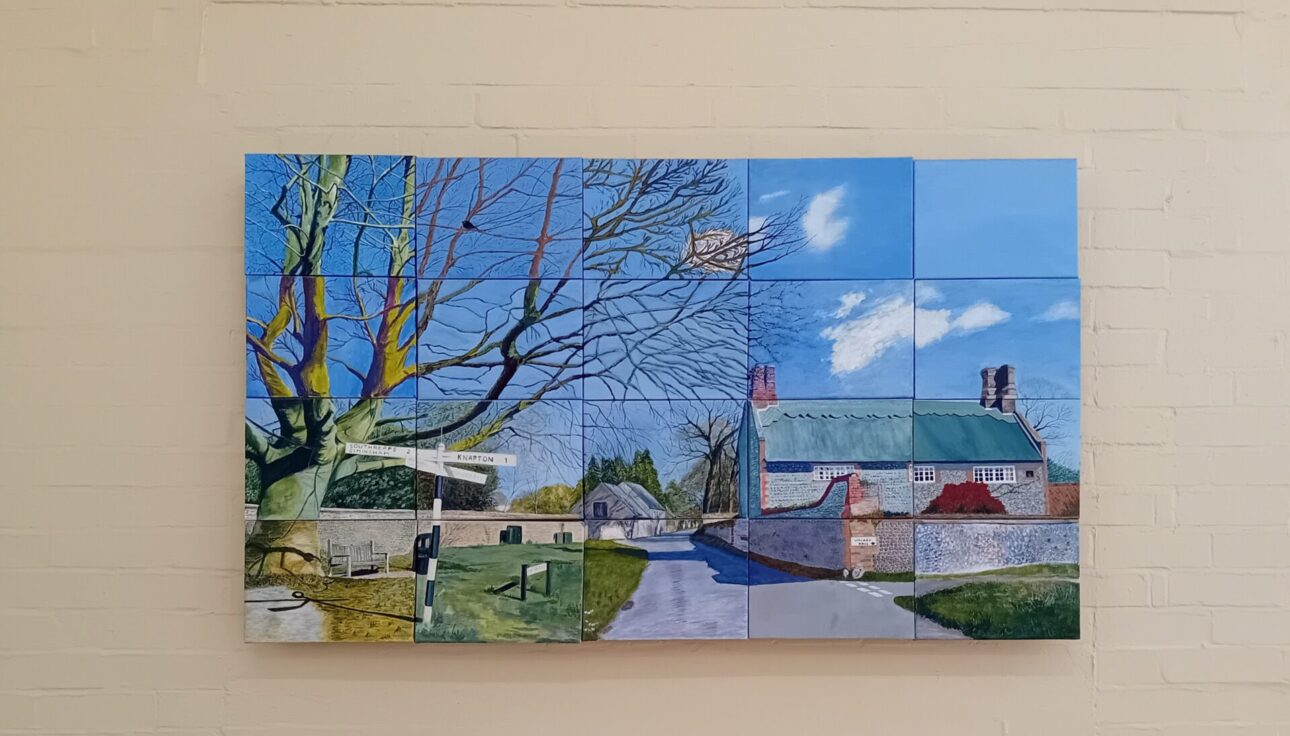
To start with, Jan would produce photographic images of designated subjects, in her case, local views of Trunch, a village situated in North East Norfolk. She proceeded to segment each image into equally sized squares or rectangles, depending on the dimensions of the whole image. Students would randomly draw their section out of a hat. To allow the whole to be read more coherently when fully assembled, Jan marked important connecting points for each segment to help guide the painters, working in their own style, to scale and position their part of the painting.
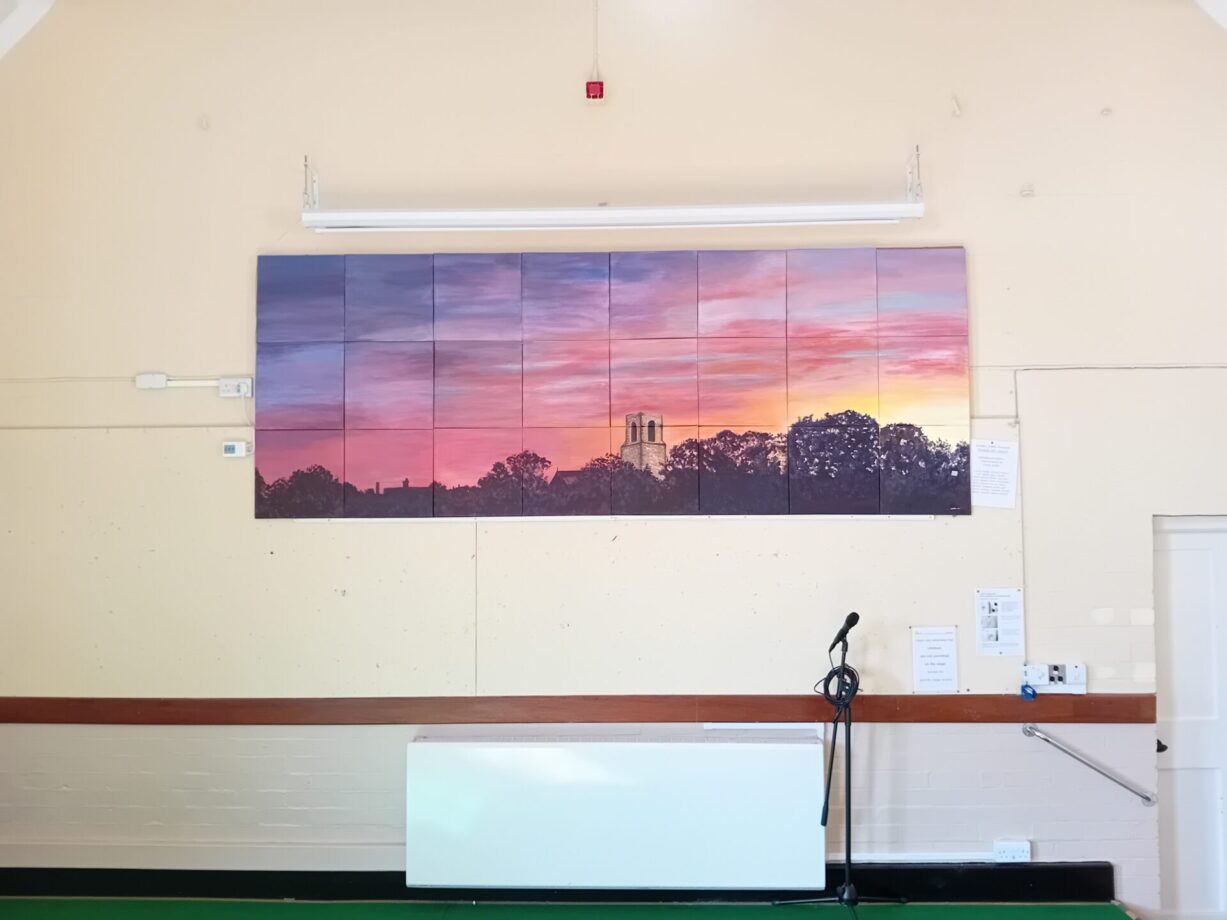
The artists’ palette was restricted to only three colours, cadmium red and yellow and ultramarine blue plus white, with the idea to keep the work as tonally even as possible. The students would have to use their painting skills and imagination to mix up their own different hues and tones, corresponding to their part of the painting. This would emphasise multiple and individual interpretations within the whole assembled painting, offering an engaging visual experience of a known and recognisable local feature. The whole process would be completed within two weeks.
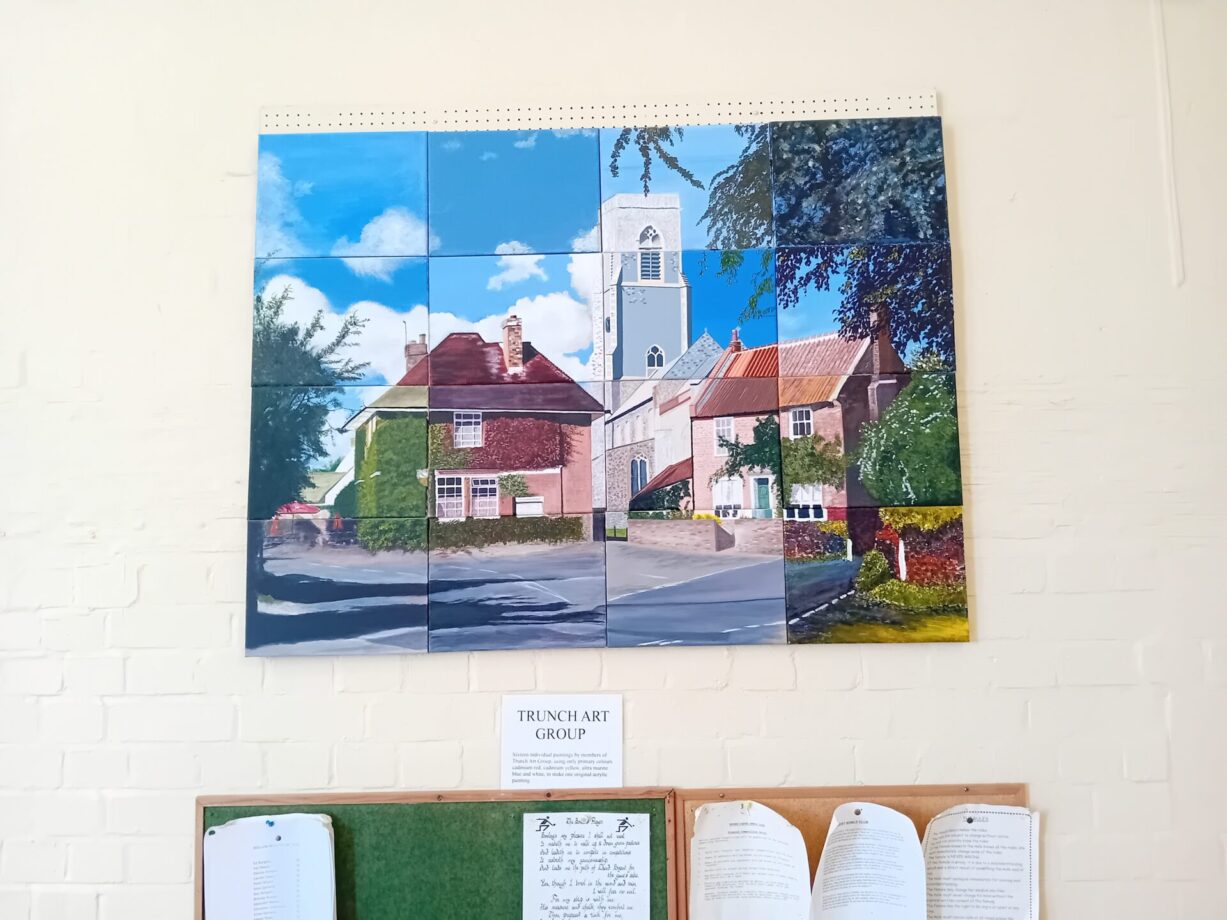
So far Jan’s painting group have completed three ‘joiners’; ‘Vine Cottage’ has 20 panels, ‘Church and Crown’ has 16 panels, and the largest ‘Trunch Church in the Evening Light’ has 24 panels. All are proudly displayed in Trunch Village Hall for all to enjoy!
Jan is a passionate artist who endeavours to share her vision and enthusiasm with others. Jan says that she has “always painted” as long as she can remember. Essex born, Jan in her early years did not possess coloured paints, so made do with anything she could find to make marks, often quietly drawing on the wall behind the family settee. At the age of seven, Jan entered a painting competition organised by the Daily Mirror national tabloid newspaper to depict ‘Flash The Wonder Dog’. Although Jan did not have colours to work with she still managed to win the competition.
Jan attended Paston College in North Walsham, Norfolk, and successfully completed her Fine Art A’ Level with flying colours. She always wanted to attend Art College, but family related circumstances did not allow her to study her life’s passion any further. Jan is an extraordinary individual who generously contributes her time and talent to benefit her community.
Spanish artist Pablo Picasso and French artist Georges Braque created cubism, first ‘Analytical’ Cubism, later followed by ‘Synthetic’ Cubism, in Paris around 1907.
Cubism
Cubism, as a style practiced by Pablo Picasso and Georges Braque, broke from traditional perspective by presenting a single image as if seen from many different angles simultaneously. The term “Cubism” is thought to have come from art critic Louis Vauxcelles, who described Braque’s 1908 paintings as reducing forms to “cubes”.
Instead of a single, fixed viewpoint, a subject is shown from various angles at the same time. Objects and figures are broken down into distinct, geometric planes. The fragmented parts are then reassembled into an abstract form, moving away from representational realism, rejecting the illusion of depth common in earlier art practiced throughout Europe during the “rebirth” from the late 14th century, a period generally known as the Renaissance. The cubist approach resulted in fragmented, abstract works that emphasized the two-dimensional flatness of the canvas over creating a realistic illusion of depth.
Jan and her group did not employ a cubist approach; however she did restrict the colour palette, to help her students discover a new creative approach, via a fragmented pathway, towards a compelling outcome.
‘Joiners’
David Hockney’s “joiners”, developed in the early 1980s, a technique that reflects Hockney’s interest in the Cubist’s idea of presenting a subject from multiple viewpoints, and his developing interest in the way space and reality is perceived, which led Hockney to experiment with this new medium.
Assembling numerous images from different angles and perspectives to form a single composite image created his photo-collages, of many overlapping photographs. He began with Polaroids and later moved on to using 35mm film for his montages.
The photographs are taken from different angles and viewpoints, showing a subject from various perspectives simultaneously.
The photographs are arranged and pieced together without necessarily aiming for a seamless blend, embracing the disjointed edges to create a narrative quality. The overlapping images and shifts in scale and perspective highlight the passage of time and the way we perceive space in fragments, rather than a complete whole.
The technique challenges traditional photographic perspectives by capturing a sense of time and space as it is experienced, rather than as a static, single viewpoint. The final work is a single, large image made from many smaller, individual photographs.